




The
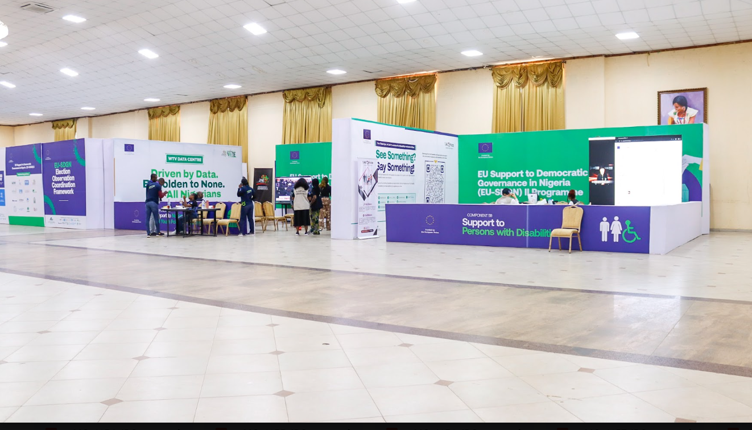
European Union, through its Support to Democratic Governance in Nigeria
(EU-SDGN) programme, has launched a pre-election
assessment report aimed at guiding stakeholders ahead of the
June 20, 2026, Ekiti State governorship election.
The
report, which evaluates the preparedness of electoral institutions,
security agencies, media, and civil society, was unveiled at a media briefing
in Abuja on Thursday.
Addressing
journalists during the launch, the executive director of the International
Press Centre, Lane Arogundade, described the assessment as “an
essential tool to strengthen democratic processes and safeguard credible
elections in Ekiti State.”
The pre-assessment report
is put together by the Civil Society cohort under the EU-SDGN programme. The
consortium comprises DAI, Yiaga Africa, the Nigerian Women Trust Fund (NWTF),
The Kukah Centre, IPC, the Centre for Media and Society (CEMESO), and TAF
Africa. It examines political dynamics, INEC’s operational readiness, security
considerations, media coverage, and participation of marginalised groups,
including women, youths, and persons with disabilities.
Key
findings highlight that, although the pre-election environment
in Ekiti is largely calm, this does not necessarily reflect a
competitive democratic space. Analysts noted the perceived advantage of
incumbency, elite consensus around the sitting governor, resource imbalances,
and divisions among opposition parties.
INEC’s
preparedness, the report states, remains an operational concern. While
continuous voter registration and other pre-election activities are
complete, a survey across the 16 local government offices indicated only a 34%
readiness rate as of April 14. Critical gaps include the late release
of election funding, the need for rehabilitation of operational
offices, vehicles, and collation centres, and incomplete preparations for over
32,000 new registrants.
Security
risks were described as low-intensity but layered, with urban violence and
kidnapping identified in specific LGAs. Other threats include vote buying,
political thuggery, disinformation campaigns, and potential militarisation
of election security. Although the Nigeria Police Force has outlined
a comprehensive deployment plan, questions remain over neutrality, professional
conduct, and funding for election operations.
The
media landscape in Ekiti is diverse but faces challenges. State-owned
outlets are constrained by limited independence, while private media confront
commercial pressures. Journalists face risks of physical attack, legal
harassment, and economic pressures that could encourage self-censorship.
The assessment also
underscores inclusion gaps. Despite supportive laws, none of the 13 political
parties fielded a female governorship candidate, and no candidate
openly identifies as a person with a disability. High nomination fees and
entrenched patronage networks continue to limit participation by women, youths
and persons with disabilities.
Speaking
at the launch, Veneza Gregory, a Programme Officer with NWTF stressed the
urgent need to enhance women’s political participation, highlighting structural
barriers, high nomination fees and the absence of female candidates in the
upcoming election. Esrom Ajanya of the National Peace Committee outlined
key security challenges, including risks of urban violence, vote buying, the
mobilisation of political thugs, disinformation campaigns, and the potential
militarisation of polling units. The Executive Director of TAF Africa, Jake Epelle
of TAF called for comprehensive measures to ensure voting accessibility for
persons with disabilities, including assistive devices, priority voting, and
collection of disaggregated data. His counterpart in Yiaga Africa, Samson
Itodo, emphasised the importance of youth engagement, civic education and
grassroots mobilisation to strengthen participation in
the electoral process. The chief executive of Centre for Media and
Society, Akin Akingulu focused on the media, underlining the need for fair,
balanced and conflict-sensitive reporting, fact-checking, and protection of
journalists against intimidation or harassment.
Together,
their contributions underscored the need for inclusive, secure and
transparent electoral processes that address the participation of
marginalised groups and maintain public trust.
The
report concludes that the June 20 election will be a crucial test of
INEC’s operational capacity and the integrity of
the electoral process. Stakeholders are urged to act on
recommendations for funding release, security planning, accessible voting,
media independence and civic engagement to ensure a peaceful, free, fair and
inclusive election.
The
full Pre-Election Assessment Report is available on the EU-SDGN
website and the platforms of implementing partners.